12 Best Goodreads Alternatives in 2027 (Tested by Reader Type)
The best Goodreads alternative overall is The StoryGraph, an independent tracker with better stats, half star ratings, and mood based recommendations. For social reading and book clubs, choose Fable. For a beautiful modern catalog, try Hardcover. For simple, private tracking, Bookmory or a Notion template. And yes, almost all of them let you import your Goodreads data, so you never start from scratch.
There is a quiet exodus happening in the book world. After years of putting up with a platform that has barely changed, readers are finally walking away from Goodreads and finding something better. If you have felt that itch too, you are in good company, and you have more great options than ever.
This guide is different from the usual list. Instead of ranking apps one to twelve, it sorts them by the kind of reader you are, because the best Goodreads alternative for a stats lover is not the best one for someone who just wants a cozy reading log. Find yourself below, and switch with confidence.
Why Readers Are Leaving Goodreads
Before the alternatives, it helps to name what actually pushes people away, because the right replacement depends on which of these bothers you most.
It is owned by Amazon. Goodreads was founded in 2007 by Otis and Elizabeth Chandler, and Amazon acquired it in 2013. For many readers, handing their reading data and reviews to Amazon, and indirectly to Jeff Bezos, is reason enough to leave and support independent tools instead.
The interface feels frozen in time. This is the most common complaint by far. The design has barely moved in over a decade, the app can be clunky, and small quality of life features readers have begged for still are not there.
No half star ratings. You cannot rate a book 3.5 stars on Goodreads, full stop. For a platform built on ratings, this omission drives readers up the wall, and it is the single feature almost every alternative fixes.
The ratings feel unreliable. Between review bombing, revenge ratings, and people rating books they have not finished, popular titles often cluster in a narrow band that tells you very little about whether you will actually enjoy them.
Best Goodreads Alternatives at a Glance
Prices change often, so treat these as a guide and confirm before you subscribe.
| App | Best for | Half stars | Web + app | Cost | Not Amazon |
|---|---|---|---|---|---|
| The StoryGraph | Stats and recommendations | Yes (0.25) | Both | Free, Plus ~$5/mo | Yes |
| Fable | Social reading and book clubs | Yes | App only | Free, paid tier | Yes |
| Hardcover | A modern, beautiful catalog | Yes | Both | Free, supporter tier | Yes |
| Bookmory | Simple, private tracking | Yes | App only | Free, paid tier | Yes |
| LibraryThing | A deep, classic catalog | Yes | Both | Free | Partly Amazon |
| BookWyrm | Open source and privacy | Yes | Web | Free | Yes |
| Pagebound | Per book discussion, no AI | No | Both soon | Free | Yes |
| Bookly | Reading habits and goals | Yes | App only | Free, paid tier | Yes |
| Oku | Clean, design led tracking | Yes | Both | Free, paid tier | Yes |
| Literal | Social discovery | Yes | Both | Free | Yes |
| BookSloth | Genre based matching | Yes (0.5) | App only | Free | Yes |
| Notion or spreadsheet | Full control, your own system | Your call | Both | Free | Yes |
Best Overall: The StoryGraph
If you want one recommendation, this is it. The StoryGraph is the alternative readers name more than any other, and for good reason. It was founded in 2019 by Nadia Odunayo, and it remains independent and Black woman-owned, which is exactly the opposite of handing your data to Amazon.
What makes it special is the data. Instead of plain star ratings, it tracks mood, pace, and whether a book is plot or character driven, then turns that into genuinely useful recommendations. Its motto sums it up: life is too short for a book you are not in the mood for.
StoryGraph does well:
- Half and quarter star ratings (0.25 increments)
- Rich stats, with pie charts and graphs of your reading
- Mood and pace based recommendations that actually fit
- Community sourced content warnings
- Monthly and yearly wrap ups, free
- One click Goodreads import
Where it falls short: the interface can feel clunky, the social side is thin compared to Goodreads, and non-English books are less well covered. A free plan does the job, and StoryGraph Plus adds advanced stats for around five dollars a month. Want the full head-to-head? See our detailed StoryGraph vs Goodreads comparison.
Best for Social Reading: Fable
If the part of Goodreads you loved was the community, Fable is the closest thing to the old social feel, rebuilt for today. It is designed around connection, with a clean, aesthetic interface that many readers adore.
Its strength is book clubs. Anyone can join virtual clubs, discussions happen inside the app, and recommendations come from authors, celebrities, and fellow readers. It even tracks TV and film alongside books, and imports your history from both Goodreads and Kindle.
Worth knowing before you switch: Fable is app-only, with no desktop website, which is a dealbreaker for readers who like tracking on a laptop. Some stats sit behind a paid tier. And in January 2025, Fable drew criticism after its AI-generated reader summaries produced offensive messages, which the company responded to with changes. If you prefer no AI at all, keep that in mind.
Best Modern Catalog: Hardcover
Hardcover is the newcomer that readers keep falling for, largely because it is simply a pleasure to use. The design is polished and modern, and it is built by a small, passionate team rather than a corporation, with no Amazon ties.
It nails the details others miss. It has half star ratings, a dedicated did not finish status, and a clever feature that calculates your audiobook progress by percentage for you. It also offers an API for tech minded readers, and community prompts where you ask fellow readers for recommendations.
The catch: it is still maturing, so you will hit the occasional rough edge, imports are not always perfect, and the review community is smaller than Goodreads for now. For a modern, non Amazon home for your library, though, it is hard to beat.
Best for Simple Tracking: Bookmory
Not everyone wants pie charts and social feeds. If you just want a clean, private place to log what you read, Bookmory is a quiet favorite. It does one thing well: tracking.
There is no social network to maintain and no overwhelming stats dashboard. You log books, write notes for yourself, and even time your reading sessions if you like. It is calm, simple, and personal, exactly what a lot of readers actually want.
The trade off is obvious: no community, and no deep recommendations. If that is a feature rather than a flaw for you, Bookmory is lovely.
Best for Privacy and Open Source: BookWyrm
For readers who care deeply about owning their data, BookWyrm is the principled choice. It is open source, ad-free, and decentralized, part of the fediverse, the same network that powers Mastodon.
That means no company owns your reading life, no algorithm mines your habits, and no ads follow you around. You can still follow other readers, write reviews, and track your books, all in a community oriented, anti corporate space.
It asks a little more technical comfort than a polished commercial app, and the catalog is smaller. But for privacy first readers, nothing else on this list matches its values.
Best Classic Catalog: LibraryThing
LibraryThing has been around since before Goodreads, and that longevity shows in its enormous, carefully maintained catalog. Readers describe it as a quiet, peaceful corner of the internet that never got worse over time.
It is completely free, lets you scan barcodes to add physical books, offers detailed stats, and can even track movies and TV. The interface is old school rather than slick, which fans find charming. One honest note: LibraryThing is partly owned by Amazon, so it is not a clean break if that is your goal.
The Exciting Newcomers: Pagebound, Literal, Oku, and BookSloth
A wave of fresh alternatives is worth knowing, because they each fix something specific:
- Pagebound gives every book its own discussion forum, like a Reddit thread inside the book, and the founders have said they will not add AI. It is gamified with points and levels to keep you reading, which readers find genuinely addictive.
- Literal is design forward and social, good for discovering books through a clean, visual feed.
- Oku is a minimalist, beautifully designed tracker for readers who want something modern without the clutter.
- BookSloth matches you to books by genre, worldbuilding, writing style, and more, with reading clubs and half star ratings.
None is as established as StoryGraph, but each is a real option if its angle fits you.
Best for Total Control: Notion or a Spreadsheet
Here is the option the app makers will not mention: you do not need an app at all. Many committed readers track everything in a Notion template, a Google Sheet, an Excel file, or even ebook software like Calibre.
The appeal is total control. You decide the columns, the ratings, the tags, and the stats, and nobody owns your data but you. Notion has excellent free reading tracker templates you can copy and tweak. The downside is no built in community or recommendations, so it suits readers who track for themselves, not to socialize.
How to Export Your Goodreads Data Before You Switch
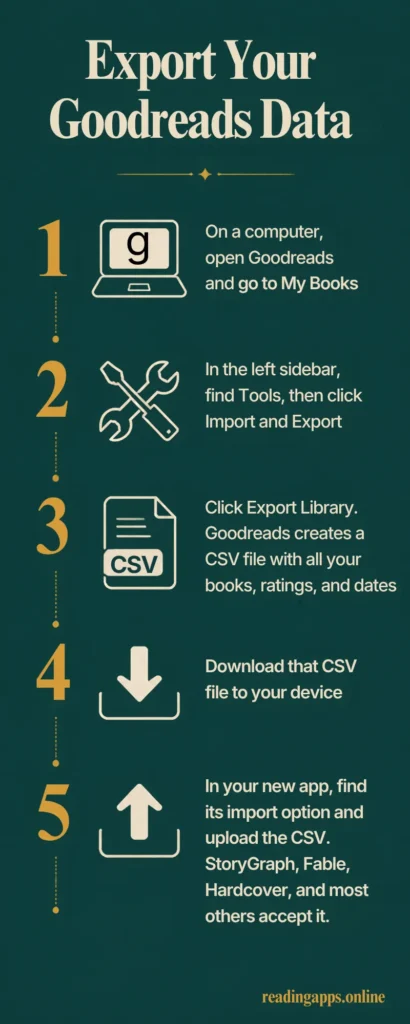
This is the question that stops most people from leaving, and the good news is it is easy. You do not have to re enter years of books by hand. Here is the simple process:
- On a computer, open Goodreads and go to My Books.
- In the left sidebar, find Tools, then click Import and Export.
- Click Export Library. Goodreads creates a CSV file with all your books, ratings, and dates.
- Download that CSV file to your device.
- In your new app, find its import option and upload the CSV. StoryGraph, Fable, Hardcover, and most others accept it.
One tip: after importing, spend a few minutes checking the results. Imports occasionally mislabel a few books, for example tagging ebooks as audiobooks or getting a read date wrong, so a quick cleanup is worth it.
Where Goodreads Still Wins
To be fair, Goodreads isn’t all bad, and it’s worth noting what you give up by leaving. It still has the largest catalog of books and the biggest pile of reviews anywhere, so obscure titles are more likely to be listed there.
It also syncs directly with Kindle, has a huge active user base, and its annual Reading Challenge is genuinely motivating. Many readers happily use a new app for tracking while keeping Goodreads open just to read reviews. There is no rule that says you must pick only one.
Which Goodreads Alternative Should You Choose?
To make it simple, match the app to what actually bothers you about Goodreads:
Most readers find their footing within a week, especially once their Goodreads library is imported. The best way to decide is to pick one, import your data, and give it a month.
Looking for reading apps beyond tracking? See our full guide to the best apps for reading, covering ebooks, audiobooks, and free library books for every kind of reader.
Frequently Asked Questions
Every app here was assessed on hands on use and on what real readers report. Prices and features change often, so please verify current details with each platform before signing up.